Call for Papers
Vol 2, Issue 2 — December 2026
Join our upcoming issue on "Journal of Intelligent Machine Learning and IoT Enabled Applications". We invite researchers to submit their latest findings.

Editor-in-Chief: Dr. K. Saravanan
Publishing Model: Open Access (No APC)
Online ISSN: 3139-3667

Scientific
Intelli-Press (SIP)
Conflict of Interest Policy
A conflict of interest exists when any association—between authors, reviewers, or editors could compromise, or appear to compromise, the impartial submission, review, editorial decision, or publication of a manuscript. Conflicts may involve individuals or organisations and may be financial or non-financial in nature.
Authors must disclose all relationships, affiliations, and activities that could influence or be perceived to influence their manuscript. These may include employment, consultancy roles, research funding, stock ownership, patent licenses, honoraria, advisory positions, or any other potential competing interest.
Reviewers must disclose any relationships or activities that could affect their impartial evaluation of a manuscript. If a conflict exists—actual or perceived—they must decline the review. Reviewers must not use the review process to advance personal interests or gain access to unpublished work for their own benefit.
Conflicts of interest should be disclosed through the reviewer form provided in the reviewer login portal.
Editorial decisions must be made by editors who have no financial, professional, or personal conflicts related to the manuscripts under consideration. Editorial staff involved in the decision-making process must disclose any potential conflicts and recuse themselves from handling affected manuscripts.
Information obtained through manuscript handling must never be used for personal advantage.
Editors submitting their own manuscripts to the journal must delegate all editorial responsibilities for that submission to another qualified editorial staff member and must not participate in related discussions or decisions.
Vol 2, Issue 2 — December 2026
Join our upcoming issue on "Journal of Intelligent Machine Learning and IoT Enabled Applications". We invite researchers to submit their latest findings.
| Year | No. of Manuscripts Received | Documents Published | Percentage (%) of Acceptance |
|---|---|---|---|
| 2025 | 35 | 12 | 34% |
| 2026 | 10 | Current Issue Ongoing | - |

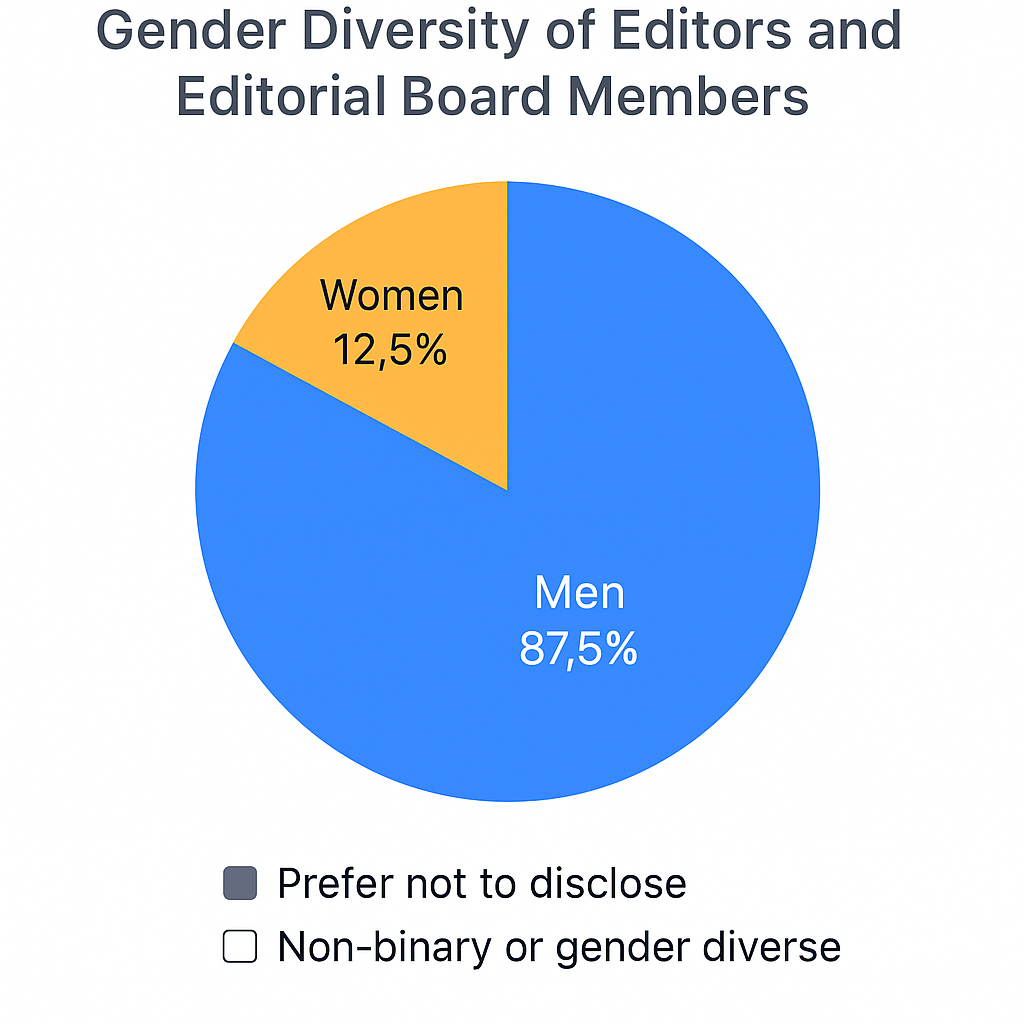
We value transparency and inclusion in the gender distribution among our editorial team: