Call for Papers
Vol 2, Issue 2 — December 2026
Join our upcoming issue on "Journal of Intelligent Machine Learning and IoT Enabled Applications". We invite researchers to submit their latest findings.

Editor-in-Chief: Dr. K. Saravanan
Publishing Model: Open Access (No APC)
Online ISSN: 3139-3667

Scientific
Intelli-Press (SIP)
Plagiarism refers to the act of presenting another person’s work, ideas, or expressions as one’s own without proper acknowledgment. Self-plagiarism occurs when authors reuse their previously published content—including text, data, figures, or results—without appropriate citation or disclosure. The JIML-IEA journal reviews all submitted manuscripts for plagiarism and takes strict action when detected.
Manuscripts with more than 30% similarity are immediately rejected. If the similarity is below 30%, authors will be required to revise the manuscript and provide correct citations wherever necessary.
To ensure originality, JIML-IEA uses Turnitin to detect text similarity, duplication, and uncredited use of previously published material.
Plagiarism involves using someone else’s words, ideas, or creative expressions without giving proper credit. It can occur in several forms, including:
Copying text verbatim from another source.
Reusing portions of another author’s work, such as figures, tables, equations, or illustrations that are not common knowledge, without citation.
Copying or downloading text, images, diagrams, or other media from the internet without acknowledgment.
Adopting sentences or paragraphs from existing publications without referencing the source.
Plagiarism is not only unethical but also a violation of copyright laws.
Self-plagiarism refers to reusing a significant portion of one’s own previously published work without proper citation. However, reusing material from one’s prior publications—such as conference papers—with clear and explicit referencing is acceptable and does not constitute self-plagiarism. In such cases, quotation marks are not required, but the original source must be appropriately credited.
Sometimes authors may unknowingly reproduce text or ideas without proper citation. It is the author’s responsibility to understand the difference between quoting, paraphrasing, and summarizing, and to follow correct citation practices to avoid unintentional plagiarism.
Deliberate plagiarism occurs when authors knowingly copy content or ideas without acknowledgment. This includes submitting purchased, borrowed, or copied work as one’s own. Such acts are considered serious ethical violations and will result in strict consequences.
Vol 2, Issue 2 — December 2026
Join our upcoming issue on "Journal of Intelligent Machine Learning and IoT Enabled Applications". We invite researchers to submit their latest findings.
| Year | No. of Manuscripts Received | Documents Published | Percentage (%) of Acceptance |
|---|---|---|---|
| 2025 | 35 | 12 | 34% |
| 2026 | 10 | Current Issue Ongoing | - |

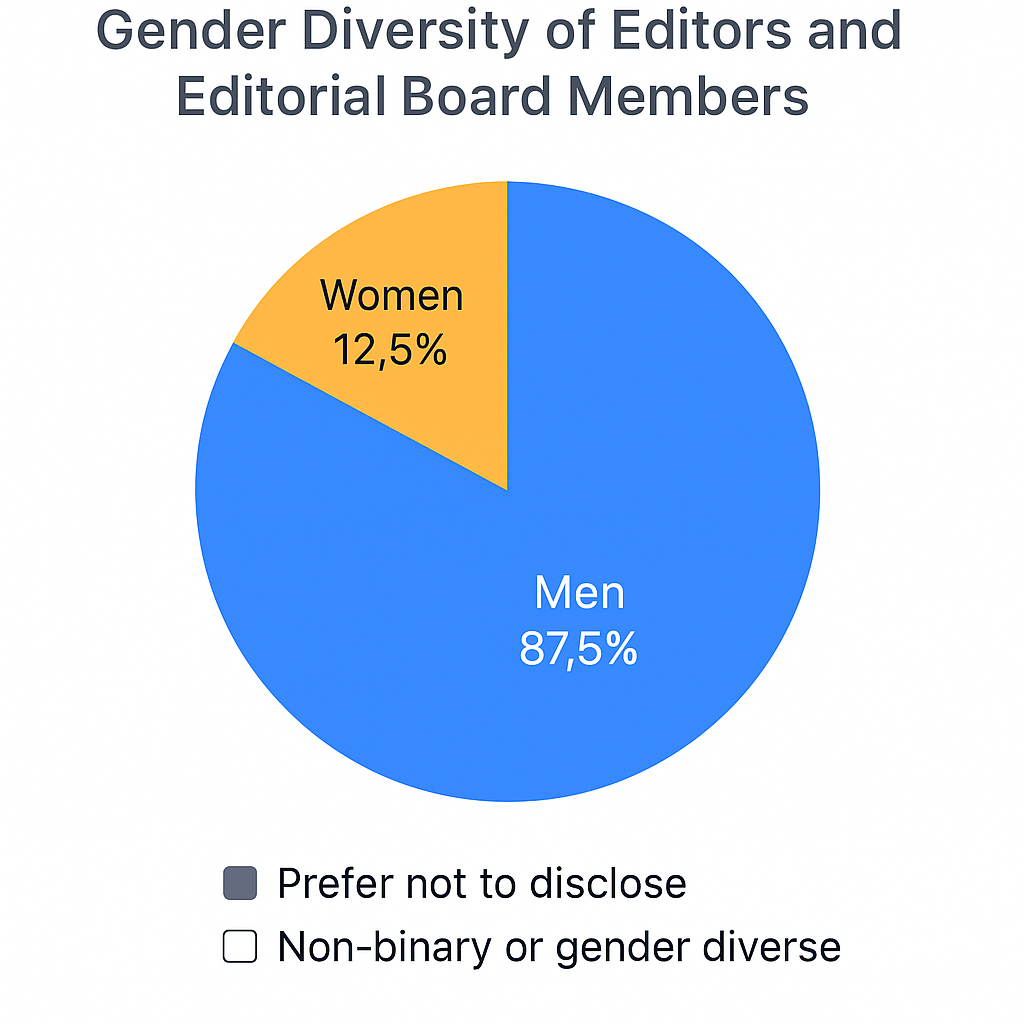
We value transparency and inclusion in the gender distribution among our editorial team: