Call for Papers
Vol 2, Issue 2 — December 2026
Join our upcoming issue on "Journal of Intelligent Machine Learning and IoT Enabled Applications". We invite researchers to submit their latest findings.

Editor-in-Chief: Dr. K. Saravanan
Publishing Model: Open Access (No APC)
Online ISSN: 3139-3667

Scientific
Intelli-Press (SIP)
Concerns related to research ethics or suspected violations of the journal’s publishing ethics-whether raised before or after publication-should be reported directly to the journal. When requested, the identities of those reporting the issue will be kept confidential.
Upon receiving any allegation of misconduct, the editors will initiate a thorough investigation. Authors may be asked to provide supporting documents, data, images, or other relevant materials. Editors may also consult with external experts, and the journal may contact the concerned institutions or organisations to request a formal inquiry.
If an article is found to violate ethical publishing standards-such as duplicate submission, data fabrication, plagiarism, citation manipulation, or false authorship claims-it will be rejected.
If the article has already been accepted and posted as “Online First,” it will be removed from the website and accompanied by a withdrawal notice. Failure by authors to respond to editorial communication after review and provisional acceptance will also be treated as withdrawal.
If the article has already been formally published, it will be retracted in accordance with the COPE Retraction Guidelines.
The journal adheres to the COPE flowcharts (https://publicationethics.org/guidance/Flowcharts) for handling all types of misconduct.
Depending on the severity of the violation, the journal may also take the following actions:
Ban the authors from submitting to the journal for 1–3 years.
Prohibit the authors from serving as reviewers or editors.
Report the misconduct to the authors’ institutions, employers, or funding agencies.
Minor unintentional errors by authors may be addressed through a corrigendum, while errors introduced by the publisher will be corrected through an erratum.
Vol 2, Issue 2 — December 2026
Join our upcoming issue on "Journal of Intelligent Machine Learning and IoT Enabled Applications". We invite researchers to submit their latest findings.
| Year | No. of Manuscripts Received | Documents Published | Percentage (%) of Acceptance |
|---|---|---|---|
| 2025 | 35 | 12 | 34% |
| 2026 | 10 | Current Issue Ongoing | - |

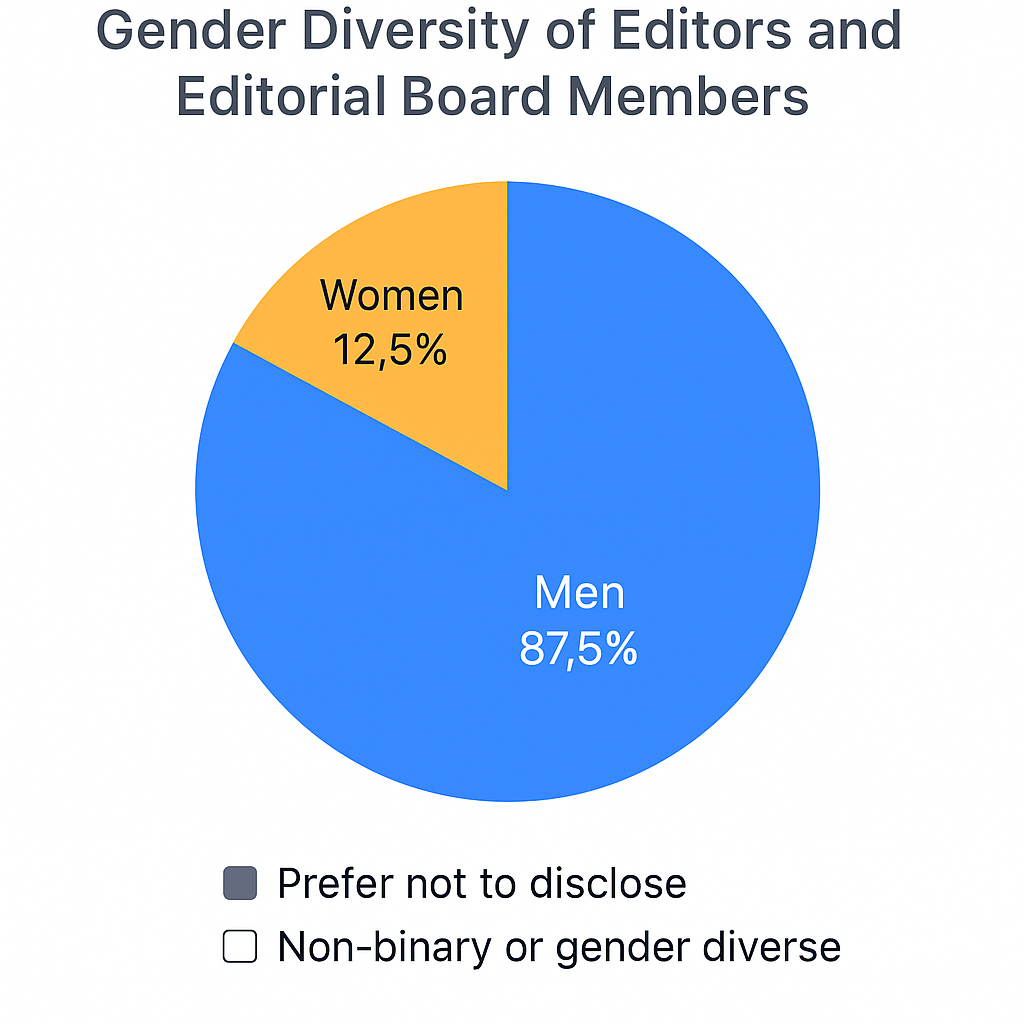
We value transparency and inclusion in the gender distribution among our editorial team: