Call for Papers
Vol 2, Issue 2 — December 2026
Join our upcoming issue on "Journal of Intelligent Machine Learning and IoT Enabled Applications". We invite researchers to submit their latest findings.

Editor-in-Chief: Dr. K. Saravanan
Publishing Model: Open Access (No APC)
Online ISSN: 3139-3667

Scientific
Intelli-Press (SIP)
The Journal of Intelligent Machine Learning and IoT Enabled Applications (JIML-IEA) recognises the growing use of artificial intelligence (AI), including generative AI and large language models, in scholarly research and writing. The journal supports the responsible, transparent, and ethical use of AI tools while maintaining authors' accountability for their work.
AI tools must not be listed as authors or co-authors. Authors remain fully responsible for the originality, accuracy, integrity, and ethical compliance of their manuscripts.
AI tools may be used for:
Language improvement, grammar checking, and clarity.
Code suggestions, subject to verification by the authors.
Literature-search assistance, with independent verification of references.
Summarising or paraphrasing authors' own work.
Research applications where AI itself is part of the study.
Authors must not use AI tools to:
Submit unreviewed AI-generated content as original scholarly work.
Generate fabricated references, data, results, or images.
Manipulate figures or images in a misleading manner.
Circumvent plagiarism or originality checks.
Any substantive use of AI beyond routine language editing should be disclosed in the manuscript. Authors should mention the AI tool used, its purpose, and the relevant sections or aspects of the manuscript.
Example:
"The authors used ChatGPT (OpenAI) for language improvement during the preparation of this manuscript. The authors reviewed and edited the output and take full responsibility for the final content."
AI-generated or AI-modified scientific figures and images should not be used in a misleading manner. Where AI-generated content is an essential part of the research, its use must be clearly identified and described.
Authors are responsible for verifying all AI-assisted content, references, data, code, and results before submission. The journal may request clarification or supporting materials where the originality or authenticity of AI-assisted content is in question.
This policy will be reviewed periodically to reflect developments in AI technologies and emerging standards in responsible scholarly publishing and research ethics.
Vol 2, Issue 2 — December 2026
Join our upcoming issue on "Journal of Intelligent Machine Learning and IoT Enabled Applications". We invite researchers to submit their latest findings.
| Year | No. of Manuscripts Received | Documents Published | Percentage (%) of Acceptance |
|---|---|---|---|
| 2025 | 35 | 12 | 34% |
| 2026 | 10 | Current Issue Ongoing | - |

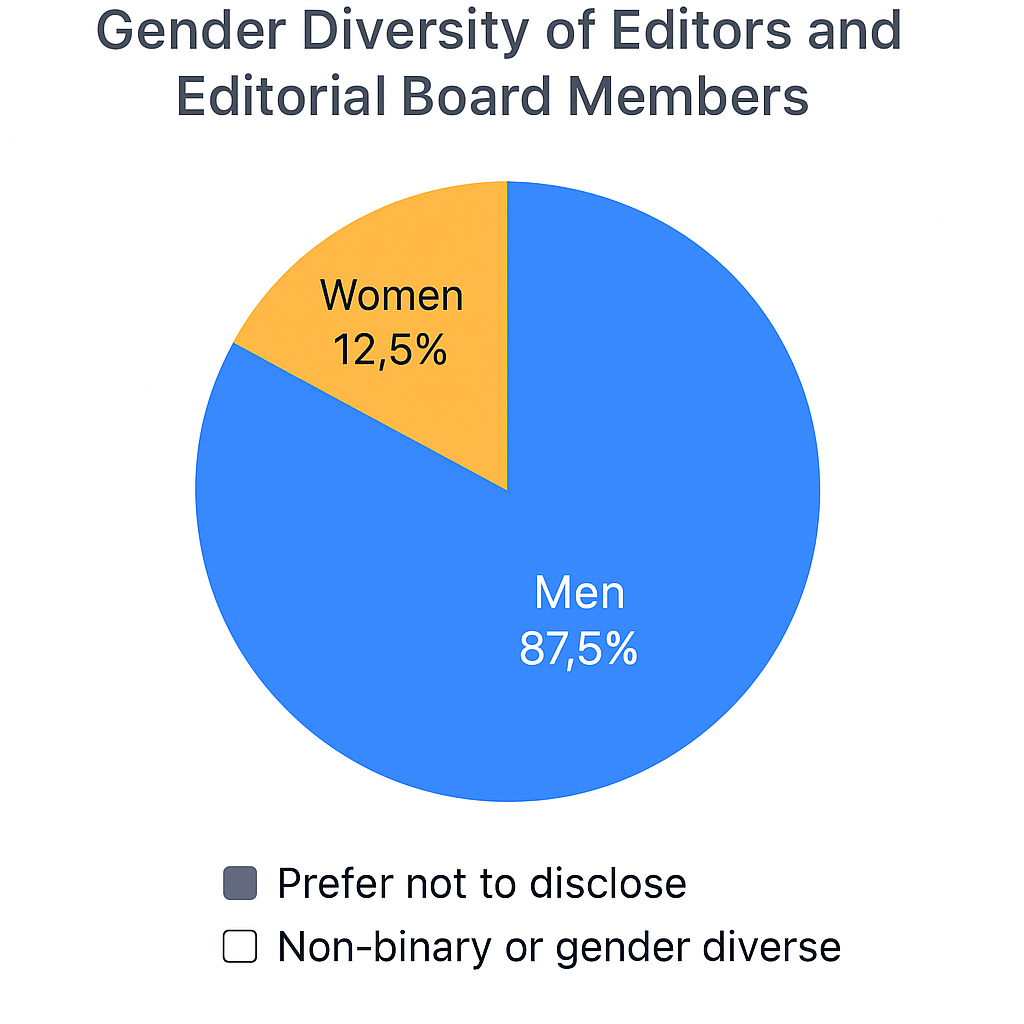
We value transparency and inclusion in the gender distribution among our editorial team: